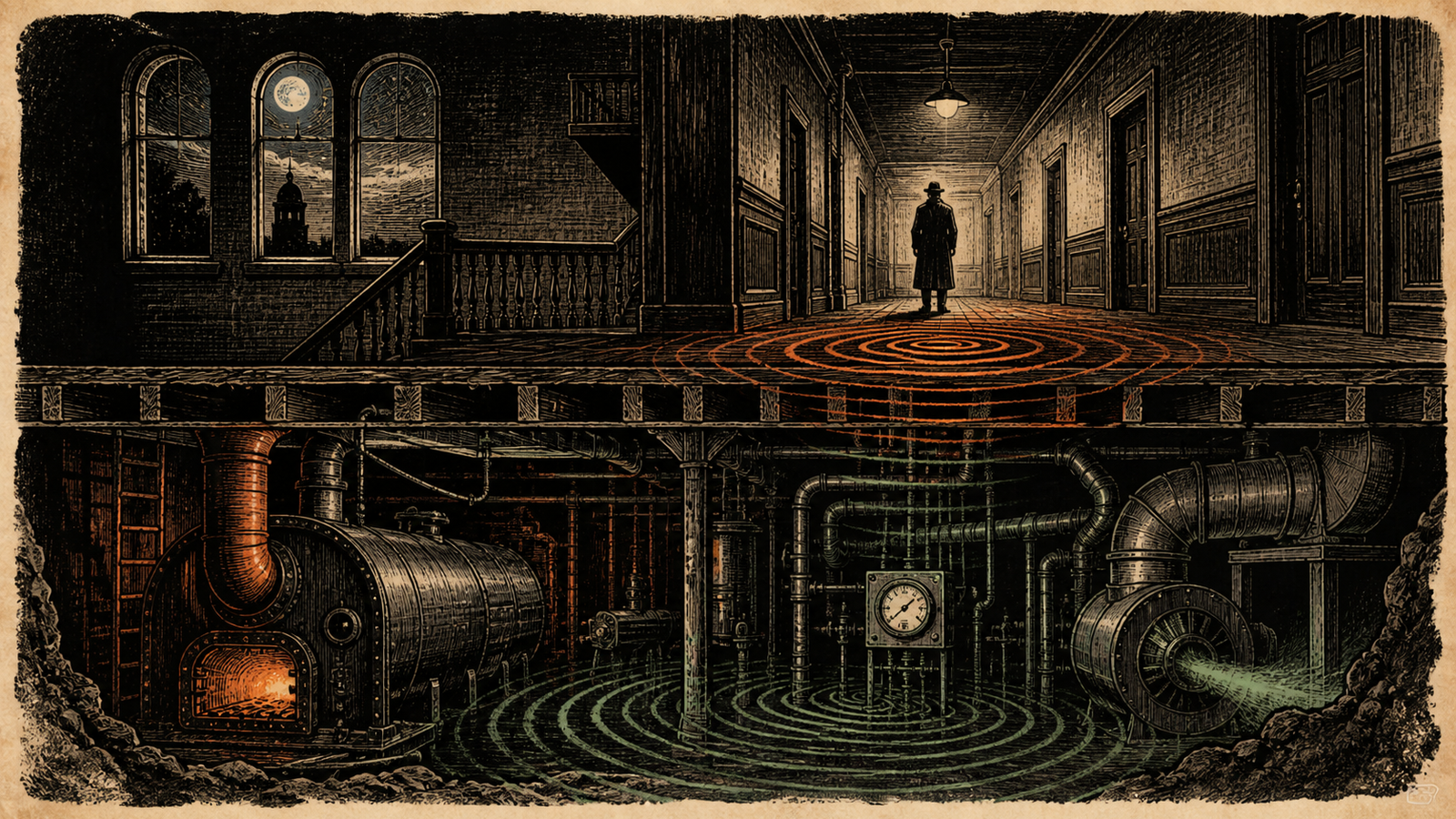
SUMMARY: A controlled experiment found that volunteers exposed to sound near 18 hertz showed higher cortisol and more negative reactions even though they could not reliably tell when the infrasound was present.
CATEGORY: News
EDMONTON, Alberta — August 5, 2026 — The uneasy feeling inside an old building may sometimes begin below the range of ordinary hearing. A small controlled study published April 27 in Frontiers in Behavioral Neuroscience found that exposure to infrasound near 18 hertz was associated with elevated stress hormone levels and more negative emotional responses, even when participants could not reliably detect that the sound was present.
Infrasound is acoustic energy below 20 hertz, the conventional lower boundary of human hearing. It can be produced naturally by storms, volcanoes and interactions between air and water, and mechanically by ventilation, heating equipment, traffic, power systems and low-rumbling pipes. People may not consciously hear those frequencies, but the new experiment suggests the body can still respond.
Researchers from MacEwan University and the University of Alberta recruited 36 undergraduate volunteers. Each listened to either calming instrumental music or unsettling horror-style ambience for roughly five minutes. Hidden subwoofers delivered infrasound at about 18 hertz to half the participants while the other half heard only the assigned music. The researchers collected mood reports and saliva samples before and after exposure to measure cortisol, a hormone associated with stress.
Participants could not identify the presence of infrasound better than chance. Yet the infrasound groups showed higher salivary cortisol and reported greater irritability and disinterest; they also appraised the music as sadder. The pattern appeared across both the calming and unsettling music conditions, which led the authors to describe infrasound as a possible environmental irritant capable of shifting mood and stress response without conscious auditory detection.
The results are intriguing, but they are not a laboratory discovery of ghosts—or a universal explanation for haunted places. The experiment used a small convenience sample, mostly women, drawn from university psychology classes. It tested a brief, controlled exposure near 18 hertz, not a night in an allegedly haunted building. The authors themselves call for larger and more diverse studies, while earlier human research on infrasound has produced mixed findings.
The paranormal connection comes from context. If a building’s machinery, pipes or ventilation create low-frequency energy, a visitor might experience discomfort without locating its source. In a place already described as haunted, that bodily signal could acquire a supernatural interpretation. The study supports the first link in that chain—infrasound can influence stress and appraisal—but it does not prove the second. Expectation, architecture, lighting, air quality, suggestion and personal belief can all shape an unusual experience.
That distinction matters because dramatic claims have followed infrasound for decades. A frequently repeated story proposes that frequencies around 19 hertz can vibrate the eye and create apparitions. The evidence for that specific claim remains anecdotal rather than established by controlled experiments. A 2020 scholarly review of haunted-house research concluded that environmental factors alone are insufficient as a general explanation for why certain places gain haunted reputations or produce anomalous reports.
The 2026 experiment is more modest and more useful. It joins a subjective measure—how participants described their feelings—with a physiological one—the cortisol detected in saliva. The volunteers did not need to believe they were in a haunted place, and they were not told when the low frequency was active. That design helps separate an actual exposure effect from a response produced only by suggestion.
For paranormal investigators, the practical lesson is not to dismiss a witness. It is to expand the instrument kit. A site survey can document heating and ventilation cycles, nearby traffic, machinery, air quality, temperature, lighting and low-frequency sound before extraordinary conclusions are drawn. Recording the environment preserves the experience while testing whether the building itself is transmitting a signal.