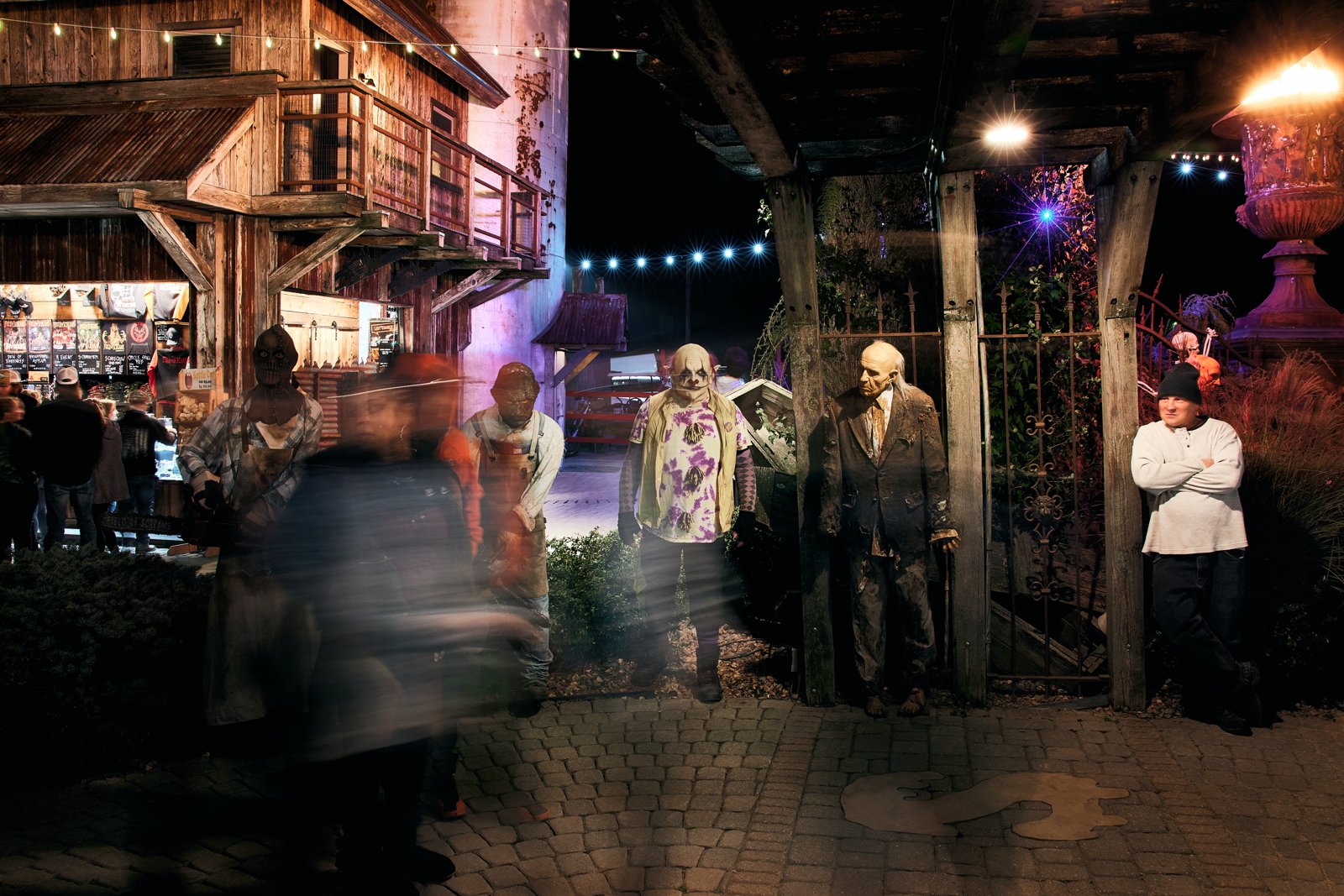
MOUNTVILLE, PA — On October 2, Ghost Signal Radio's very own reporter, Hannah Wolfe, visited Field of Screams in Lancaster County, Pennsylvania, to meet with co-founder Jim Schopf. What followed was a conversation about growing up on a farm, scaring neighborhood kids, leaving behind a career in teaching, and somehow turning a childhood pastime into one of Pennsylvania's best-known haunted attractions. Field of Screams has been frightening visitors since 1993.
Today, it's a sprawling operation with elaborate sets, hundreds of actors on its roster, and a full-time crew working throughout the year. But listening to Jim talk about the early days, it's hard not to picture a couple of kids hiding behind hay bales, waiting for somebody to walk past. And, as it turns out, that's not far from how it all started.
## A Couple of Kids and an Old Barn
Before there was a Field of Screams, there was a working family farm. The buildings that now house the Den of Darkness and Frightmare Asylum were ordinary barns. The parking lots were farmland. There were no monsters roaming the property, unless you count Jim and his brother Gene. When they were young, the brothers visited a local haunted house called Scream in the Dark, an attraction put together by a youth group called Youth for Christ.
They loved it. So much, in fact, that they went home and decided to make their own. They used one of the family barns, invited friends and members of their sister's Brownie troop, and spent their time jumping out of hiding places to scare whoever came through. That was pretty much the entire operation. As they got older, life moved on. Gene became a teacher, and Jim headed to Millersville University to study education.
But they never quite lost their enthusiasm for frightening people. In 1993, they decided to give it another shot. Jim was 19 and still studying at Millersville, and Gene was already teaching. This time, instead of using the barn, they cut a path through the cornfields, borrowed their father's tractor and wagon, and started a haunted hayride. Around 2,000 people showed up that first year, according to Jim. Some visitors enjoyed it so much that they asked whether they could join in and scare people themselves.
There wasn't much of an audition process. If you wanted to help, somebody handed you a mask. Costumes weren't particularly elaborate, either. A scary face and maybe a dark gown were enough to get the job done. It worked.
## When Scaring People Became a Full-Time Job
For years, Field of Screams was something the brothers worked on while maintaining their teaching careers. They'd spend their days at school and their evenings working on the attraction. Every season brought new ideas, improvements, and more people coming through the gates. Eventually, it became too much to juggle. After roughly ten years, Jim and Gene made the decision to leave teaching and concentrate on Field of Screams full-time. What's interesting is that neither brother had originally planned on making a living this way.
Jim told Hannah they never had a formal business plan, attendance projections, or a five-year strategy. They were doing something they enjoyed, and people kept showing up. In 2008, the Travel Channel featured Field of Screams, introducing the attraction to a much larger audience. By then, the little haunted hayride had grown well beyond anything the brothers imagined back in 1993. Jim offered Hannah a comparison that really puts that growth into perspective.
The waiting line for Frightmare Asylum today is about as large as the entire parking area was when Field of Screams first opened. Think about that for a moment. What once accommodated the whole operation's parking is now roughly the size of the line for just one attraction.
## The Night a Squirrel Shut Down the Hayride
When you're running a haunted attraction, especially one spread across a working farm, things occasionally go wrong. Jim recalled two occasions when Field of Screams lost power during operating hours. One happened at the Den of Darkness after a transformer along the main road failed. The emergency lights came on as they were supposed to, and the final groups made their way through with the scenes illuminated. Instead of the usual dark and frightening experience, those visitors got something closer to a behind-the-scenes tour.
The other outage was a little more unusual. A squirrel got onto a power line near the hayride and caused an arc that knocked out the electricity. The squirrel didn't survive, and neither did the power. There were still a couple of wagons left to go through. Rather than shut everything down, the crew finished the show in the dark. Apparently, nobody complained. The visitors thought it was pretty cool. It's probably not the kind of special effect the brothers had in mind, but sometimes you work with what you've got.
## Scaring People Isn't Quite as Simple as It Used to Be
In the early days, Field of Screams didn't have a costume department. There was a box of masks, a few improvised outfits, and plenty of enthusiasm. Things are considerably different now. Jim described an operation with approximately 400 people in its actor database and around a dozen full-time employees working year-round. There are sets to design, effects to build, scenes to maintain, and actors to train. The work doesn't stop when the last visitor leaves at the end of October.
And the actors don't simply show up, put on a mask, and start chasing people. Field of Screams has its own training programs, including Scare School and Scare University. Staff learn how to frighten guests effectively while keeping everyone safe. Safety was something Jim spoke about at length. He remembered the old farm wagons, muddy parking areas, and some of the things performers used to do in the early years.
At one point, actors were jumping out of trees and landing in wagons. Jim, who wrestled at Millersville, recalled that he and his fellow wrestlers were among those pulling off some pretty wild stunts. They were young, athletic, and willing to try things that wouldn't be acceptable today. The industry has changed, and so have the rules. Jim said Field of Screams helped teach the Department of Agriculture what haunted attractions are all about. He said they take safety seriously and want every haunted attraction to maintain safety rules and regulations. The scares may be more elaborate than ever, but there's a lot more planning behind them.
## Are We Getting Harder to Scare?
Hannah asked Jim whether today's visitors are harder to frighten than the people who came through Field of Screams in the 1990s. His answer was interesting. He thinks people are harder to impress, but not necessarily harder to scare. You can spend a fortune building a convincing monster, creating a spectacular scene, or installing the latest special effect. People may admire all of it without actually being frightened. But let somebody hide around a corner and jump out when you're distracted, and your body reacts before your brain has time to catch up.
That worked thirty years ago. It still works. What has changed is who's coming through the gates. In the beginning, haunted houses were largely considered entertainment for kids and teenagers. Today, Jim sees groups of adults visiting Field of Screams simply because it's something fun to do together. They come for the scares, but also for the atmosphere, the entertainment, and the chance to spend an evening with friends. Haunted attractions have become a night out, not just something to do when you're a teenager.
## For Some People, Regular Scares Aren't Enough
Of course, there's always somebody who wants things taken a little further. That's where Field of Screams' Extreme Blackout event comes in. Jim explained that the name can be a little misleading. It's not necessarily a completely dark experience. The bigger difference is what happens to the guests. Depending on the experience, visitors might be separated from their group, placed in a cage, or find themselves in situations considerably more intense than what they'd encounter on a regular night.
The event grew out of requests from visitors looking for something more extreme. The brothers initially wondered whether there might be enough interest to offer several nights of it each season. They discovered that most people were perfectly happy with the regular attractions. Only a smaller group wanted to push things that far. So Extreme Blackout became a special event for those looking for that extra adrenaline rush. Field of Screams also holds off-season events, including Halfway to Halloween, where the themes, costumes, characters, and decorations change to give returning visitors something different.
## You Can't Keep Everything Forever
One challenge that comes with operating a haunted attraction for more than three decades is deciding what stays and what goes. Jim said the creative team has a long list of ideas they'd love to bring to life. In fact, there are more ideas than they realistically have time to build. But there's only so much room. Adding a new scene often means removing an old one, and that isn't always an easy decision.
Some scenes become favorites. People return year after year expecting to see them. Take one away, and visitors may be disappointed. The Den of Darkness is a good example of how Field of Screams balances its past with its future. The attraction