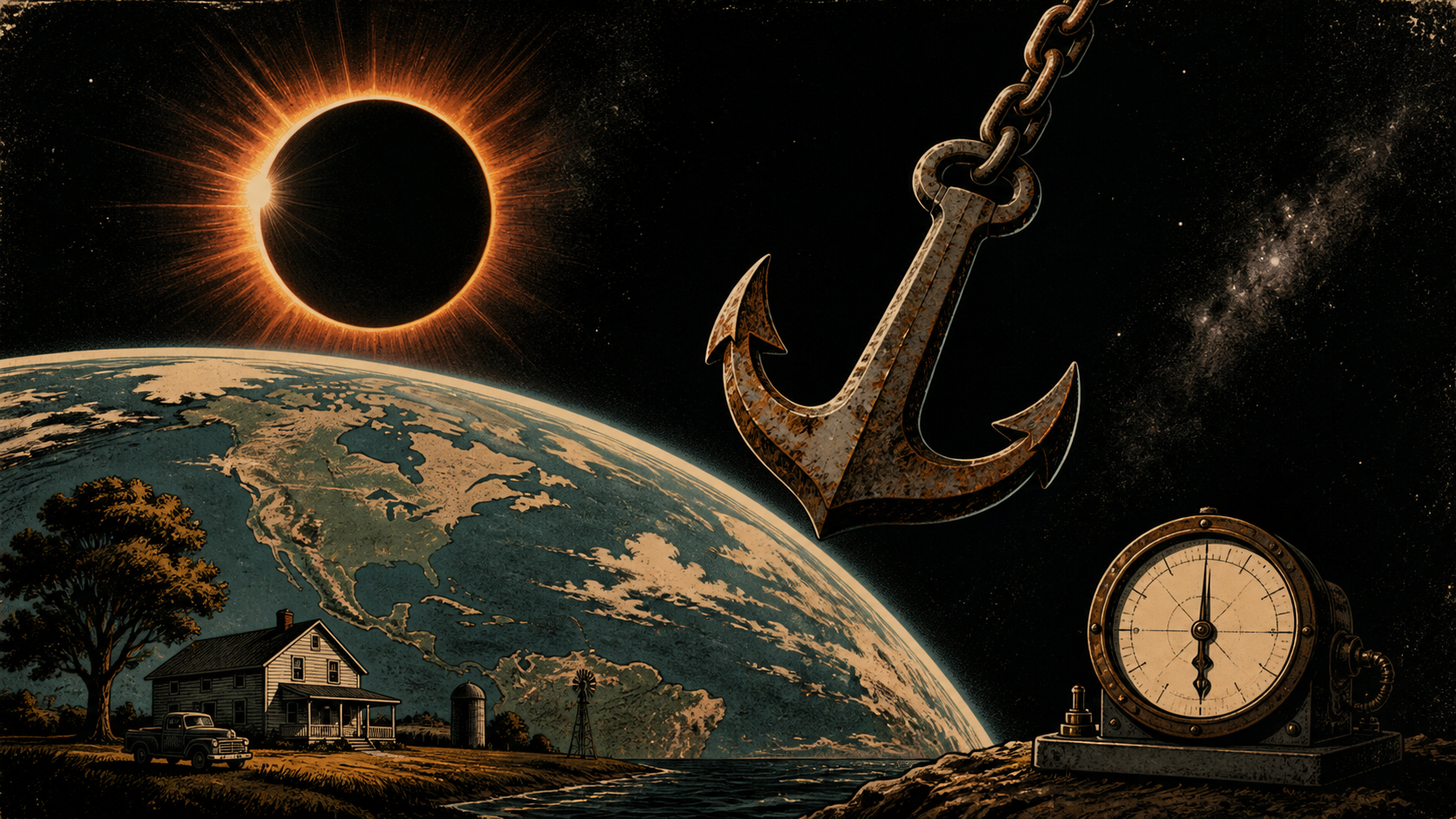
The date attached to one of the year’s strangest internet rumors has arrived. Earth did not lose gravity for seven seconds, NASA did not activate a secret $89 billion survival program, and the laws of physics did not take the afternoon off.
The false story, commonly labeled “Project Anchor,” claimed that a leaked NASA document predicted a worldwide gravitational blackout at 14:33 UTC on August 12, 2026. Versions circulating across social platforms warned of mass casualties, collapsing infrastructure and a decade of economic damage. They offered no verifiable document, no named scientific team and no evidence that such a NASA program existed.
What did happen on August 12 was spectacular enough without invention: a total solar eclipse crossed parts of northern Russia, Greenland, Iceland, Spain and a small corner of Portugal. A partial eclipse was visible across a much wider portion of the Northern Hemisphere, including parts of the United States and Canada. NASA scheduled live coverage and scientific observations of the real event.
That eclipse supplied the hoax with a useful piece of reality. By fastening an impossible prediction to a genuine astronomical date, Project Anchor made its fiction easier to repeat. Scientific vocabulary, an exact time and a large government budget gave the rumor the appearance of specificity while social video supplied the atmosphere.
NASA directly rejected the claim months before the predicted event. In a statement provided to fact-checkers, the agency explained that Earth’s gravity is determined by the planet’s mass. For gravity to disappear, the combined mass of the planet’s core, mantle, crust, oceans, water and atmosphere would have to disappear with it. An eclipse changes how sunlight reaches part of Earth; it does not switch off the force holding people, buildings and oceans to the ground.
There is also no credible evidence of a leaked “Project Anchor” dossier. Searches by fact-checkers found no reputable record of the alleged program, while the rumor’s supposed technical explanation—sometimes involving intersecting gravitational waves from black holes—did not provide a mechanism capable of canceling Earth’s gravity.
The rumor nevertheless stayed alive long enough to reach its appointed hour. Posts on August 11 and 12 continued to joke about, question or prepare for the seven-second event. That persistence illustrates a familiar pattern: once a claim becomes an entertaining story, the absence of evidence can be recast as proof of secrecy and every debunk can become another opportunity to repeat the original allegation.
The real eclipse was no less dramatic. NASA said totality lasted less than two and a half minutes everywhere along its path. The agency supported a high-altitude research flight to study the Sun’s corona and student balloon projects in Iceland and Spain to examine atmospheric changes during the temporary darkness. Those efforts produced a better mystery than the fabricated one: how Earth’s atmosphere and the Sun’s outer layers behave when the Moon’s shadow passes over the planet.
Project Anchor also arrived with a reminder about responsible viewing. Outside the brief period of totality, looking directly at the Sun requires safe eclipse glasses or a proper handheld solar viewer. Ordinary sunglasses are not sufficient. The genuine risk came from staring at the eclipse without protection—not from floating away.
Why It Matters
Ghost Signal Radio covers strange claims because strange claims matter, even when they are false. A good mystery invites investigation; a manufactured catastrophe tries to bypass it. Project Anchor borrowed the language of secrecy, science and cosmic danger, then asked audiences to treat repetition as proof. The best defense is not ridicule but verification: find the original document, identify the accountable source, test the mechanism and compare the claim with what credible evidence actually shows.
The internet promised seven seconds without gravity. What it delivered was a real eclipse, a durable hoax and a useful demonstration of how easily fact and fiction can occupy the same shadow.