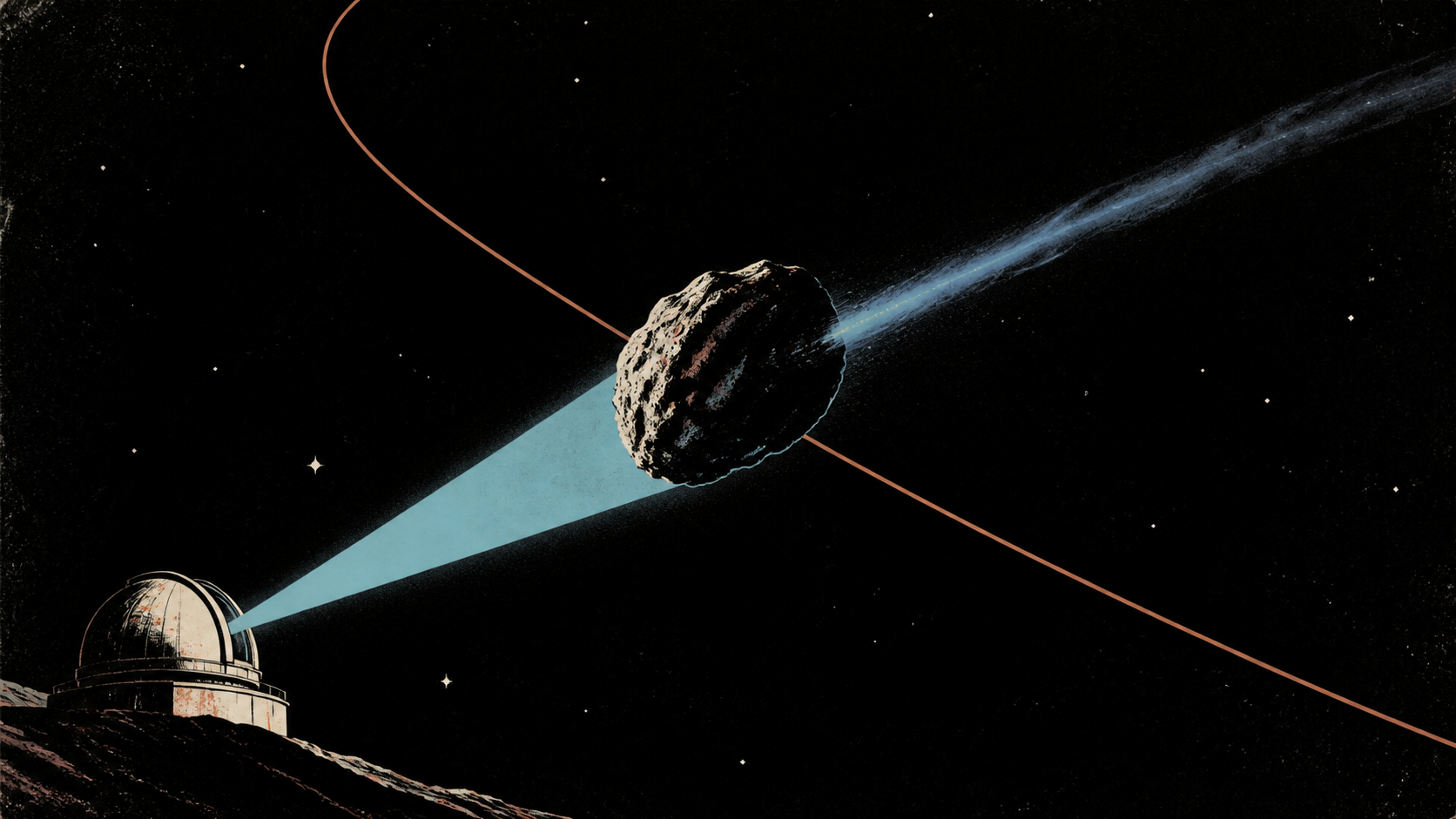
For years, the near-Earth object known as (875163) 1998 SH₂ looked like an asteroid. There was just one problem: it wasn't moving like one.
Astronomers tracking the object found subtle changes in its orbit that couldn't be adequately explained by gravity alone. That raised an intriguing possibility—something else might be giving the object a tiny push.
Researchers went looking for the culprit.
A study published in Nature Astronomy examined observations of 1998 SH₂ spanning from 1998 through 2025. Its unusual acceleration was consistent with cometary outgassing, in which material escaping from an icy body acts like a minuscule thruster and gradually alters its motion.
But there was a mystery. Earlier images hadn't shown the familiar signs of an active comet.
Using powerful telescopes capable of detecting extremely faint activity, researchers finally found what had been hiding in the darkness: a weak, low-surface-brightness tail.
The asteroid was a comet.
NASA's Jet Propulsion Laboratory says the discovery demonstrates that cometary activity can be so faint that an object may remain misclassified for decades. That also means 1998 SH₂ may not be alone. Other objects currently cataloged as near-Earth asteroids could potentially be weakly active comets whose behavior has simply been difficult to detect.
The distinction matters beyond astronomical bookkeeping. Cometary outgassing can alter an object's trajectory, making accurate modeling important when scientists evaluate the future paths and potential impact hazards of near-Earth objects.
Sometimes the first clue isn't what astronomers can see.
It's an object refusing to move the way it should.